30.7.10
A Moment of Clarity
"It’s as if one were seeing a frame for the first time: the image opens up, the frame opens, then the screen, the theatre, and finally us too, everything is opened and we gaze wide-eyed into this most intensive clarity"
(Nicole Brenez)


(From La Vie Nouvelle by Philippe Grandrieux)
24.7.10
Ice Cold

It's been rather busy as of late, but I'm to the point now where I feel inattentive not putting up something at least once a week, however insubstantial it might seem. Considering it originates with a source other than myself perhaps I'm not doing myself any favors with this new post (something I've been guilty of quite a bit lately), but it was such an eloquent and pertinent response that I was compelled to share with those who might not have been privy to it otherwise. Recently a oft-evolving debate has taken place on Frameworks mailing list regarding a wide range of issues, but perhaps most importantly the possibilities (both positive and negative) of the film and digital mediums. Eventually this led to a somewhat rhetorical query as to why Brakhage didn't make his 1994 hand (Wink-wink)-painted film Black Ice on video. Pip Chodorov, the multifaceted founder of Paris based distributor Re:Voir, replied with the following:
"A) You know that Brakhage's hand-painted films at that time were based on poetic visions of real-world inspiration: Chartres Series was inspired by the stained-glass windows of Chartres and in their particular blue color that he strived to remember ; Autumnal by the colors and feelings of the season, etc. Black Ice was made after he fell on black ice and the visions that gave him. Just like a poet trying to communicate a deep feeling from one human to another through the clunky words of everyday language, he picked up his film, paints, brushes and tools, sat in the cafe in Boulder and scratched, scraped and painted these visions onto pieces of film. The work was physical, manual and it was about making an imprint and impression on that solid material that would also be projectable as a visual, meaningful, beautiful, communicative image in light. The first impulse was then to make painterly gestures, not with a keyboard and mouse, and those gestures, those imprints by those thumbs, are visible on the screen today.
B) These sources of inspiration are about light (transparency and opacity) and color: blue glass, black ice... Working with film material and paint is also about transparency and opacity and color. There is a direct relationship there, unlike the indirect relationship of a computer emulating the way something could look ("virtual" is the term I think).
C) The painted strips were then used as a base to be optically printed following a score. Brakhage himself did not do the printing, but carefully noted his ideas for Sam Bush, the technician at Western Cine. A fugue of rhythms and patterns were created from the painted material. In the case of Black Ice, the image turning and zooming in gives us the feeling of falling into the blackness. The black of film, being a total absence of light, is really a black void compared to the grey of the video screen which is illuminated even when there is no picture. This gives Black Ice almost a 3D effect, pitching forward and losing consciousness.
D) If you have only seen Black Ice on DVD, of course you won't have the experience of these colors and this depth. As I wrote on FrameWorks August 25, 2003, the MPEG2 file on the Criterion DVD "contains less information about how the colors bleed and blend into each other, in that particular way they do in Black Ice, for example, when different hand-painted stocks are superimposed in the printer. There are blues blending into whites blending into blacks, and these subtle smooth gradations and grains seem to be reduced on the DVD to fields of hues of delimited color, with shapes to them, shapes with contours instead of hazy edges. There seem to be less of a range of subtle colors, a reduced palette." And on 17 June 2005 I added "The colors may look bright and beautiful but there is a lot of detail from the film that is missing on the DVD. They used a clever compression strategy that makes the work look good, but quite different from the original. I suppose that is a matter of taste at this point, the way things are going." I think, Matt, that you are right when you say Brakhage could have made a film like that on video, if you are refering to the DVD experience, but the film experience is quite different and I don't think the particular qualities of this film could be made on a computer as we know them today. The algorythms that have been developed and the way in which programmers and chip designers have chosen to manipulate pixels when representing light have led computer graphics in a certain direction from which there is little chance of return to that creative experimental space where Vanderbeek, or Whitney, or Paik, or Tambellini, found themselves in the 1960s, excited by what computer graphics could become. Brakhage in 1994 was still excited by film graphics, and Black Ice is a great example of a film that comes straight out of an idea applied to a manual, painterly technology, that would be hard to approach using information technology." - Pip
I would like to stress that by highlighting this I don't mean to denigrate the dvd/blu-ray put out in any way/shape/form, hopefully some of my previous posts have spoken to the extreme gratitude I have and will continue to have for many long years to come, but instead to offer a platform for further insight into why the film medium is so integral to many of these works.
[Speaking of which, I think so far with this blog I've been somewhat guilty of a lack of attention to many of the fascinating explorations taking place in the digital realm, the possibilities of which are quite staggering. I hope to push that pendulum a bit further towards the middle where it belongs on here [see: the sub-title of the blog] in the near future...

17.7.10
Mare's Tail/Monkey's Birthday

(David Larcher)
It was a few weeks ago while perusing Wheeler Winston Dixon’s The Exploding Eye: A Re-Visionary History of 1960s American Experimental Cinema, a valuable book that is more or less a brisk, mouth-watering tour through some non-existent and mostly forgotten film archive, that I came across a description of an artist whose work upon retrospection seemed to have been gestating somewhere in the back of my mind for quite some time. It was a British artist by the name of David Larcher, who has worked ambitiously in the digital format for quite some time after making the transition relatively early on, but the particular source of fascination was two UFO’S [unidentified filmic objects] created in the 60s and 70s entitled Mare’s Tail (1969, 160 min) and Monkey’s Birthday (1975, 360 min.). They seem to have sprung from the same imaginative well that brought forth many of the most recognizable works of the American avant-garde during the time, cosmically epic films filled to the brim with grand and often times mystical aesthetic ideas (specific comparisons have been made to Brakhage’s The Art of Vision and Isou’s Venom and Eternity, and speculatively I wonder if his influence is to be found in some of the work of Reble, Reeves, Smith, Fouchard etc.). Over time they have developed something of a mythic status and seem to exist primarily in the memories of a few who have long past had the opportunity to experience them, so in lieu of an personal first-hand account [for the short time-being], here are some such memories:
---

On Mare’s Tail:
“Mare’s Tail is an epic flight into inner space. It is a 2 and 3/4 hour visual accumulation in colour, the film-maker’s personal odyssey, which becomes the odyssey of each of us. It is a man’s life transposed into a visual realm, a realm of spirits and demons, which unravel as mystical totalities until reality fragments. Every movement begins a journey. There are spots before your eyes, as when you look at the sun that flames and burns. We look at distant moving forms and flash through them. We drift through suns; a piece of earth phases over the moon. A face, your face, his face, a face that looks and splits into shapes that form new shapes that we rediscover as tiny monolithic monuments. A profile as a full face. The moon again, the flesh, the child, the room and the waves become part of a hieroglyphic language… 'Mare’s Tail' is an important film because it expresses life. It follows Paul Klee’s idea that a visually expressive piece adds ‘more spirit to the seen’ and also ‘makes secret visions visible’. Like other serious films and works of art, it keeps on seeking and seeing, as the film-maker does, as the artist does. It follows the transience of life and nature, studying things closely, moving into vast space, coming in close again. The course it follows is profoundly real and profoundly personal: Larcher’s trip becomes our trip to experience. It cannot be watched impatiently, with expectation; it is no good looking for generalization, condensation, complication or implication.” - (From Dwoskin's Film Is, where that mental seed was initially planted)
"It is utterly affirming and engrossing in its scale and breadth but also in its intimacy and tenderness, focused as it is on a creation myth that moves from the strange swarming birds to the birth of the filmmaker's child. Mare's Tail delves into the world where the camera acts as a protagonist and within its loose indefinable structure one can always find oneself. It is a fitting conclusion to an inspiring, diverse and incredibly accomplished season of films that testifies to the incredible possibilities of Cinema, from creation to exhibition. With a film like Mare's Tale, a key success has been achieved. Here is a legendary, but almost forgotten film that has been dragged from the recesses of time and allowed to shine in the full critical and historical context of the season. With this season, like the films, a complete synthesis of passion, research, theory and experimentation has managed to collect and re-ignite a core period of experimental cinema." - (George Clark)
“A film that is undoubtedly one of the most important produced in this country and that stands comparison with the best from the United States. It’s as if it were the first film in the world. When Mare’s Tail first appeared it was compared to Brakhage’s Art of Vision, as an examination of ways of seeing. The comparison can be taken further: as Brakhage is the to the New American Cinema, it seems to me, so Larcher should be considered to the New English Cinema… Mare’s Tail is not only about vision but proposes an epistemology of film, particularly in its first reel: revealing basic elements of film in an almost didactic fashion: grain, frame, strip, projector, light. We see a film in perpetual process, being put together, being formed out of these attitudes. The first reel is a ‘lexicon’ to the whole film – to film in general – holding together what is essentially an open-ended structure to which pieces could be continually added and offering us a way to read that film. It is at once a kind of autobiography and a film about making that autobiography.” - (Simon Field)
---

On Monkey’s Birthday:
"Monkey’s Birthday extends that inner voyage into an externalised odyssey in which Larcher and his crew wander across Europe. Years of travelling and filming were finally edited into the six hours of footage which represents 'Monkey’s Birthday'. The film is at once a diary of that voyage, a romanticisation of the quest implicit in the conceit of the wandering protagonist, and a universalisation of that quest beyond the individual protagonist" - (Henrik Hendrikson)
"In his film 'Monkey's Birthday' (1975) David Larcher used diaristic footage as a basis for a long, highly romantic mediation on light and color that was substantially structured through re-photography (optical-printing). Besides being based around the LFMC, most of these artists shared a common preoccupation with the material qualities of film and with the nature of illusion, duration, and the structuring of experience." - (The British avant-garde film, 1926-1995: an anthology of writings)
"The movie is a third-ear, third-eye diurnal of four years in the Global-Trucking-Company-where-the-truck-occasionally-turns-into-a-metallic-Stonehenge-slab-of-white-light-integrating-theley-lines-of-technology-into-Titan-tracks. It should be buried alive in the Embankment time-capsule, shown translated into Martian gossip on holographic ticker-tape in Piccadilly Circus. 'The emotions travel 30,000 times faster than the interlect,' Gurdjeff— & a generous genius has stretched the celluloid durex further than anyone else, & snapped it to give birth to a trucking feast of instinct & visionary acupuncture for the pineal gland." - (HeW)
And now from the man himself, a 2005 interview with Dr. Jackie Hatfield...
One wonders what have and what will become of the many films like these, works willing to throw everything out on the table for the viewer to grapple with, most likely sitting away on some dusty archive shelf just waiting to be rediscovered. The mind reels at the possibilities given a chance to run wild among those lovely metal canisters...
Those feeling especially adventurous can attempt to navigate Larcher’s website, which is an electronic rabbit hole that I’ve only just begun to venture down…
And speaking of archives, if you haven’t discovered the newly revamped Anthology Archives website, take time to do so immediately. As of now it offers just a small glimpse into what could potentially develop into a fully integrated online library, perhaps eventually serving as a digital alternative to that aforementioned ‘wild run’…
(Thanks to Mark Webber and Steve Polta for their assistance)
8.7.10
Keeping Score

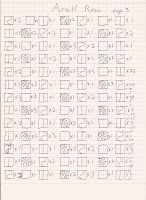
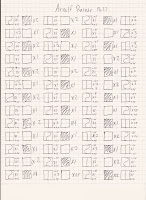
(picture courtesy of Huckleberry Lain)
"Arnulf Rainer is more complex. It is built of 16 large units of 576 frames each (that is 24 squared), each of which are composed of 'themes' lasting 288, 192, 144, 96, 72, 48, 36, 24, 18, 16, 12, 9, 8, 6, 4 and 2 frames and exploring all possible permutations. Because there are 2 possible permutations for one frame (black/white), 4 possiblilities for two frames (black/white - black/black - white/black - white/white), eight possibilities for three frames, etc, for only 24 frames there are already 4096 possibilities. For this reason, Kubelka applied esthetic criteria to choose which of the perumatations would be used. The basic elements or microstructures are based on the permutations of 1, 2, 4, 8, 12 and 24 frames, built up to the 576-frame-long large units. This goes for the image (black/white) as well as for the sound (silence/white noise [the white noise was provided by Pontus Hulten of the Moderna Museet in Stockholm]). The sound follows its own similar structure alongside the image; they rarely coincide light with noise, black with silence." - (Pip Chodorov)
---
"Kubelka's films do not in general have static 'formulas' that generate them. There are rules at work, to be sure, in the construction of the three 'metric films', of which 'Arnulf Rainer' is one, but they are the kind of rules one might find in early Western classical music, that is, music pre-1750, which create structures and make restrictions but are not fully 'generative'." - (Fred Camper)
---
The following is a handwritten transcription of the 'score' to Kubelka's flickering wonder Arnulf Rainer by Huckleberry Lain , from a print obtained with the assistance of Andrew Lampert and John Mhiripiri of the Anthology Film Archives. It was Kubelka's contention that with such a score the film could be reproduced after all other means of display had been lost. The film is an essence, in every sense of the word. Used with permission.






---
Subscribe to:
Posts (Atom)