28.4.10
Shadow Man
Heading back to the 70's where we recently had a chance to gain some insight into Robert Breer's artistic process with the help of Jonas Mekas and P. Adams Sitney, the following is a lovely and lengthy 1974 Film Culture interview with Ken Jacobs (and Jerry Sims) conducted by Lindley Hanlon in preparation for a forthcoming filmmaker profile [no, this isn't a broken record, yes, it will be coming soon].


26.4.10
The Heroic Journey
I make this post with the promise that original material will be forthcoming, but in the mean time there are still a few past articles I would like to make available that I think are very much worth your time and consideration [apologies for the slight blurring, it's an amateur undertaking after all]...


(all images from Quick Billy by Bruce Baillie)
21.4.10
STEREO SOUND AND VISION

(Hologlyphic Funkalizer)
SAVE THE DATE!!!
STEREO SOUND AND VISION - A night of independent stereoscopic productions, featuring several innovative alternative stereoscopic techniques plus live music
April 24th, 2010 8:30pm, $7.77
ATA Gallery, 992 Valencia (@ 21st), San Francisco
KERRY LAITALA & EATS TAPES + PAD MCLAUGHLIN + HOLOGLYPHICS
"Kerry Laitala, maker behind The Muse of Cinema brings an extraordinary new dimension to our microcinema screen...that is, of DEPTH! This true Frisco original has seized upon a retinal quirk, the ChromaDepth Effect, and gleefully exploited the phenomenon with a delirious dose of Kodachrome. This stereoscopic spectacular is accompanied by the electronic hues of phonic faves Eats Tapes. Preceding the Chromatic Cocktail serving is the high craft of 3-D vets Pad McLaughlin and Bob Bloomberg, with Pad's own debut Strata, Bob's Day of the Dead ethnographic, and a 3-wall in-depth immersion! In the Landing Area, Hologlyphics will be showing Stereoscopic video synthesis without 3D glasses, along to live music. Infinite views are available from multiple perspectives. All Hologlyphic imagery is generated in real-time and interactive."
Those fortunate souls in the San Francisco area looking for a little depth-ual healing are highly encouraged to attend. For more on this intriguing extravaganza please check out OTHER CINEMA...

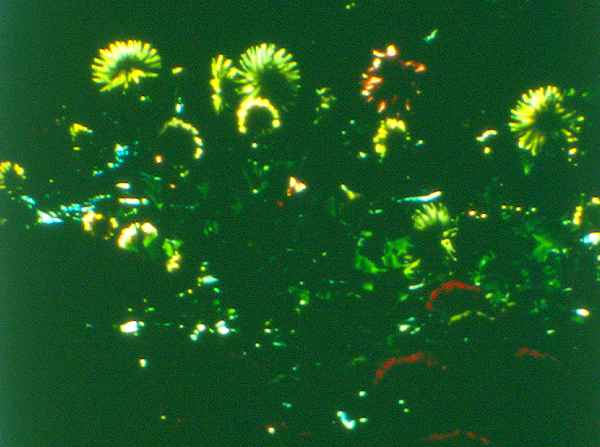
(Orbit by Kerry Laitala)
13.4.10
Passing Through
Brakhage's 1990 film Passage Through: A Ritual is by all accounts one of his most singular achievements (in a career no doubt filled to the brim with singularity). Two aspects in particular seem to serve its distinction; first, the subtle darkness that comprises the majority of its running time and second, the music of Philip Corner woven intricately into its being. The story behind its making is best recounted by Brakhage himself:
"When I received the tape of Philip Corner's Through the Mysterious Barricade, Lumen 1 (after F. Couperin), he included a note that thanked me for my film, THE RIDDLE OF LUMEN, he'd just seen and which had in some way inspired this music. I, in turn, was so moved by the tape he sent I immediately asked his permission to "set it to film." It required the most exacting editing process ever; and in the course of that work it occurred to me that I'd originally made THE RIDDLE OF LUMEN hoping someone would make an "answering" film and entertain my visual riddle in the manner of the riddling poets of yore. I most expected Hollis Frampton (because of Zorn's Lemma) to pick up the challenge; but he never did. In some sense I think composer Corner has - and now we have this dance of riddles as music and film combine to make "passage," in every sense of the word, further possible."
Naturally the combined input of these two great artists create an experience very different from that of their individual contributions, nevertheless Corner's exquisite score is very much worth listening to alone for its own considerable reward. Thanks to Simon Evnine at The Mysterious Barricades such an experience is possible...(scroll down a little bit to find the post).

9.4.10
Body Shots
Revisiting a subject that came to the forefront here a few months back, one that continues to be of considerable concern, I thought I would post the following very interesting article by the great Robert Kelly that appeared in the No. 31 Winter (1963-64) issue of Film Culture.


5.4.10
Brown Monet
“Monet is an artist that I have always greatly admired. His use of colour through water and sky to convey his emotional state has had a great influence on me. Whether it was the first rays of light glinting the water’s edge or the magic time just before nightfall, Monet’s sense of colour and colour conveyance has always been perfect. I have used my techniques of alchemical film to translate onto film my impressions of Monet’s sense of colour, water, sky and his most powerful icon the water lily. Using my toning, liquid emulsion, reticulation, dried crystal bleach formations and stacking techniques to just name a few I have translated the Monet experience onto the surface of my film.”
-- (Carl Brown)

(Water Lilies by Claude Monet)

(Blue Monet by Carl Brown)

(Weeping Willow and Water-Lily Pond by Claude Monet)

(Blue Monet [right side] by Carl Brown)

(Blue Water Lilies by Claude Monet)

(Blue Monet by Carl Brown)

(Water Lilies by Claude Monet)

(Blue Monet [right side] by Carl Brown]

(Waves and Rocks at Pourville by Claude Monet)

(Blue Monet [right side] by Carl Brown)

(Water Lilies and Agapanthus by Claude Monet)

(Blue Monet [left side] by Carl Brown)

(Water Lilies by Claude Monet)

(Organic Lesions by Carl Brown)
2.4.10
Brakhage Symposium 2010 Recap
(better late then never.....then again perhaps not....I won't make any guarantees, but I've been told if you blink rapidly while reading the following prose it will appear less stilted than it actually is....)

 (The Crazy Ray by Rene’ Clair)






Several weekends ago at the University of Colorado in Boulder, the university Stan Brakhage taught at for many years and one of the handful of experimental filmmaking havens around the country, held the sixth annual incarnation of the Brakhage Symposium. Centered around two programs of differing approaches stretched across three lengthy yet wondrous days, one by Ed Halter and the other by Christina Battle and Jennifer Peterson, the symposium presented a collaborative gathering of those involved with the field in various capacities to celebrate and explore the continuing legacy of one of the greatest of all light poets.

The inaugural program, entitled "Repetition, Remaking and Reuse" by Ed Halter, sought to explore the underlying question of what it means to repeat (in aesthetic rather than pathological context). Kicking off with a performance of Steve Reich’s Pendulum Music in which four microphones hang directly above their respective speakers and subsequently are left to swing in a pendulum motion creating a panoply of rhythmically alternating feedback pulses, the keynote address by Annette Michelson quickly established the engagingly heady tone that would permeate the first two days. Michelson, whose essay Camera Lucida/Camera Obscura remains one of the most significant texts on Brakhage’s editing theory and of whom Brakhage praised as “one of the great prose writers of our time…who is able to make language be both specific and metaphorical at the same time”, focused her lecture on what she termed the ‘savage thought’ of both Brakhage and Michael Snow with regards to their cinematic treatment of spacio-temporality. Highlighting a line starting with Rene Claire’s 1925 film The Crazy Ray, she posited the development of various modes of temporal cinematic control (i.e. slow-motion, reverse-action, etc.) as a means of reinforcing pedagogical strength and introducing inherent humor, both naturally positive products. Conversely, such a development also had the possibility of giving the maker a false sense controlling causality and fulfilling their infantile fantasy of omnipotence. She noted that while both men seemingly took diametrically opposed approaches to the subject (Brakhage’s rapid fragmentation merging memory and anticipation into a continuous ecstatic present, Snow concentrating on distending expectation into a purely temporal experience), each were united by their near absolute disregard for what had come to be the dominant treatment of narrative driven production and a desire to undercut the aforementioned phenomenon. This line was further reinforced with the projection of both an excerpt of Brakhage’s seminal 1958 film Anticipation of the Night and Michael Snow’s One Second in Montreal, his musically informed mediation on the collision of still and moving images involving unspectacular photographs in and around the city.

(Michael Snow)
[tossing and turning in the back seat of the car, in my head a door opens, closes and then opens again]
(Inextinguishable Fire by Harun Farocki)
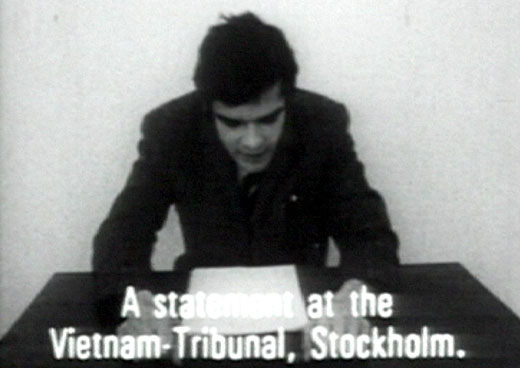
Day two began with a presentation on German Filmmaker Harun Farocki entitled “Blind Faith: Harun Farocki Envisions War” by David Joselit. Delivered with a clear and confident precision, Joselit explored Farocki’s ‘doublesness of vision’ (inner and outer/technology of war and technology of peace, etc.) in two of his works, his 1969 film work entitled Inextinguishable Fire and his more recent digital instillation piece (utilizing double projection) entitled Immersion. This ‘doubleness’ took hold in the works in three ways. First as conflict between consuming and witnessing. In Inextinguishable Fire the lesser act of consumption undermined through repetition depicted by the monotone reading of a victim’s account of the devastating effects of napalm, opposed with the more involved and responsive act of witnessing depicted by Farocki burning his own arm with a cigarette. Second as analytic vision and synthesized vision, the analytic only seeing parts of the whole, thereby disowning responsibility and creating unexpected results once synthesized vision is enacted. Lastly as action and reenactment, exemplified in Immersion by soldiers virtually re-experiencing traumatic wartime situations with therapeutically inclined software (the fact, though not indicated directly by the instillation itself, that the very same software is used to train soldiers for combat AND entertain gamers on their couch presents a potently tragic irony, and further reinforces the idea of the analytic and synthetic visions).
(Peter Roehr)
After a brief interim Halter then presented a program of films by a variety of artists in which repetition was used in a distinct and diverse manner. In his introduction Halter made a point of linking the idea of repetition with the development of machine technology and in that spirit included works produced on a variety of technologies (i.e. 16mm, video, etc.). Among the programs highlights were Peter Roehr’s rarely seen Filmmontages, in which a single brief passage of assorted marketing footage is shown repeatedly, creating a sort of hypnotic reverie that transcends the otherwise mundane subject matter.

(Shulie by Elisabeth Subrin)
Next, Brooklyn based Elisabeth Subrin presented and discussed three works: the dual-channel instillation Lost Tribes and Promised Lands, her seminal 1997 film Shulie and the double projection Sweet Ruin. Throughout each one found past and present gently merging in an elusively lucid dialogue with time and our inability to control it. Examining repetition as an integral component of memory, both Lost Tribes… and Shulie’s shot for shot reconstruction fashioned a fascinating temporal and perceptual dialectic that played out in a remarkably subtle and somewhat haunting manner (indeed it wasn’t until after I had returned that the full impact of Shulie hit home). Perhaps described best by Subrin herself, in various ways each work exposed “edges that call out for a completion that can never be.”
(Andrew Lampert)
The second day came to a close with what turned out to be one of the great highlights of the weekend, two unscheduled 8mm projector performances by filmmaker and Anthology Archives preservationist Andrew Lampert (All Magic Sands, the performance originally scheduled, was foregone due to its complex projection requirements). Ushered in with a very relaxed and inviting air (audience members were encouraged to speak at will) the two revealed the intimate and unassuming possibilities of the small-gauge format. Lampert spoke of his performance work as being 'contracted cinema' (as opposed to the commonly used phrase 'expanded cinema'), one in which he wishes to be personally invested, “feeling it, not running it.” Blurring the illusionary boundaries between amateur and art that would come to be the focus of the Symposium’s final day, the work brought forth a warm humor all too frequently missing from these events.
[turning and tossing in the back seat of the car, wondering if my memories are all edited in-camera]
The third and final day, featuring Christina Battle and Jennifer Peterson’s program entitled “The Amateur and Avant-Garde”, sought to explore the problematic misconceptions surrounding the amateur mode of filmmaking and what is considered more vaunted forms of film art. Continuing in much the same line of communal interaction as the previous night’s performances, Lynne Kirste presented (in the true form of the word, offering interesting tidbits and answering questions throughout) a collection of home movies from the Academy Film Archive largely featuring well-known figures of the professional film industry. Of particular interest were three works from the Alfred Hitchcock collection shot in Lenticular color, which produced an often breathtaking and unexpected shifting color palette.
 (
(
(I...Dreaming by Stan Brakhage)
Phil Solomon, one of the preeminent living film artists and a close friend/collaborator with Brakhage during his later years at CU, supplied another great highlight with his brief program consisting of a few of the more intimate Brakhage films (a portion of the Songs on 8mm , Star Garden and I…Dreaming on 16 mm), as well as some of his own private home movie footage and his 1995 film The Snowman. The private footage, with live narration by Solomon, offered a rare and poignant look into the origins of some of the themes running throughout his exquisite oeuvre. After the program finished, I was again left wondering exactly what that one ephemeral aspect that accompanies the projection of these works on film was. I’m not sure it is describable, but it is most certainly something potent, something that must be preserved for others to experience (…or perhaps we should just embrace it while we still can, as Phil said before wrapping things up “if this is the end of cinema, let’s dance”).

(The Snowman by Phil Solomon)
Lynne Kirste and Andrew Lampert then sat down to field questions from the audience and speak a little bit about their experiences with archiving and the themes that had been presented throughout the day. It was during this time that an interesting dialectic arose surrounding the nature of the home movie. On the one hand it was Kirste’s experience that many of the home movies she handled offered revealing personal glimpses of moments that would never otherwise be shown in a more professional context. On the other Elizabeth Subrin pointed out that the large majority of home movies exhibited an extremely conventional and clichéd form. For her, it was as much about what is usually not shown and the reasoning behind such decisions as it was what we are actually privy to.

(Erinnerungen [Memories] by Sylvia Schedelbauer)
The concluding program, entitled “An Archive of Memory”, featured works by artists dealing with the many complexities surrounding the memory and its relationship to the moving image, including two works by Sylvia Schedelbauer, who was on hand to discuss her multifaceted approach afterwards. Born of a German father and Japanese mother, Schedelbauer’s work explored the oscillating memorial divisions of her multiethnic heritage in manner at once intensely personal and modestly universal. Comprised largely of both found footage/images and audio, her work was a tender reminder of the artist’s ability to create something lasting out of the most commonplace materials.
After a brief final panel the three-day Symposium came to a close. As a whole the Symposium stood as a compelling reminder of the endless possibilities that still exist in this vast universe of experimental film , one that will by all accounts continue to act as a light for all those intrepid explorers willing to brave its many unknown expanses.
(((The experience was not yet over, in fact perhaps the greatest highlight still awaited the following night in the form of the Vancouver Island Quartet, but that is a story for another day….)))
(A Child's Garden and the Serious Sea by Stan Brakhage, the first film in the Vancouver Island Quartet, courtesy of Fred Camper)
Subscribe to:
Posts (Atom)